

How does the autopilot work? A simple explanation for beginner pilots and aviation fans
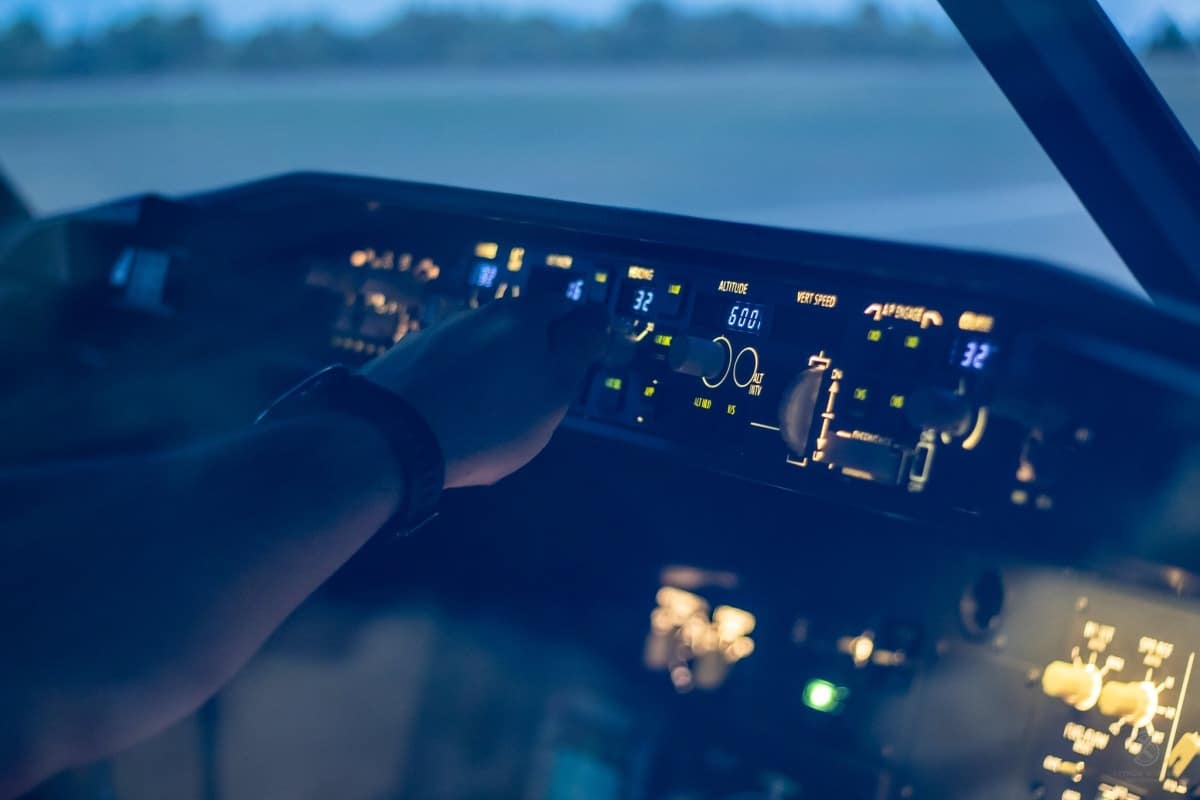 Autopilot is one of the most fascinating elements of modern aviation. To some it is „magic”, to others „a robot that flies by itself”. But the truth is much more interesting — and much more practical.
Autopilot does not replace the remote control. Autopilot helps the pilot.
And it does so brilliantly.
What does Autopilot actually do?
Autopilot is a system that can:
- stay the course,
- maintain height,
- maintain speed,
- make a turn,
- climb to a specified height,
- descending along a set path,
- fly an aircraft along a flight plan route.
In short: The pilot says where and how to fly — the autopilot does the job.
Does the autopilot take off and land?
Start — NO.
The take-off is always performed by the pilot.
Landing — sometimes YES.
Autoland only works at airports with the appropriate infrastructure (ILS CAT II/III). Then the autopilot can:
- align the aircraft with the glideslope,
- maintain a stable approach,
- touch down,
- slow down to rollout speed.
But it is still the pilot who decides whether autoland is used.
How does the autopilot „know” where to fly?
Thanks FMC (Flight Management Computer).
The pilot enters into the FMC:
- route,
- waypoints,
- Heights,
- speeds,
- SID/STAR procedures,
- approach.
Autopilot uses this data and guides the aircraft along the route like clockwork.
It's a bit like a car GPS — only 100 times more advanced.
Autopilot modes — essential for beginners
1. HDG (Heading) — maintaining heading
The pilot sets the course, the autopilot holds it.
Ideal for:
- straight sections,
- correct,
- basic sciences.
2. LNAV — lateral navigation
Autopilot is flying via waypoints from the FMC.
This is the most commonly used in-flight mode.
3. VNAV — altitude and speed control
Autopilot Sam:
- is rising,
- lowers,
- maintaining speed.
The pilot is only supervising.
4. ALT HOLD — altitude hold
Autopilot maintains the exact altitude you set.
5. APP — ILS approach
Autopilot's catching:
- localiser,
- glideslope.
This is the mode used for precision approaches.
How does an autopilot control an aeroplane?
This is beautiful in its simplicity.
Autopilot sends micro-commands to:
- wolantu (pitch & roll),
- indicator stalk,
- throttle (in automatic modes),
- spoilers (sometimes),
- applause (autoland only).
The pilot sees these movements — they are delicate, smooth, precise.
Autopilot doesn't „snatch”. Autopilot „glides”.
Can autopilot make a mistake?
Yes — if:
- the pilot enters the route incorrectly,
- the airport has a weak ILS signal,
- the conditions are extreme,
- The system will receive incorrect data.
That is why the pilot always supervises the autopilot. The autopilot does not replace the pilot — the autopilot relieves the pilot.
The biggest myth: „aeroplanes fly themselves”
No. Autopilot does not make decisions.
Pilot
- I'm planning a route,
- sets parameters,
- monitors systems,
- responds to situations,
- leads the start,
- handles most of the landings.
Autopilot is a tool — brilliant, but still a tool.
Autopilot in a simulator — why is it worth getting to know?
Because it gives:
- full understanding of modern aviation,
- the ability to fly like a real pilot,
- control over the route,
- realism,
- the thrill of „real” flying.
In the simulator you can:
- set LNAV/VNAV,
- fly an ILS approach,
- perform an autoland,
- take the controls at any time.
That's a great lesson — and a huge satisfaction.
Summary — how does Autopilot work?
Autopilot:
- carrying out the pilot's orders,
- flies an aircraft along the route,
- maintains flight parameters,
- it helps with approaches,
- sometimes I land,
- it never starts,
- never replaces the remote control.
This is one of the most important and fascinating systems in aviation.
Want to see how the autopilot works in practice?
Want to see how the autopilot works in practice?
Select a flight in the AirPoint simulator and fly the full route with LNAV/VNAV and an ILS approach.